
The Gifted Underachiever: Why Smart Kids Can't Write
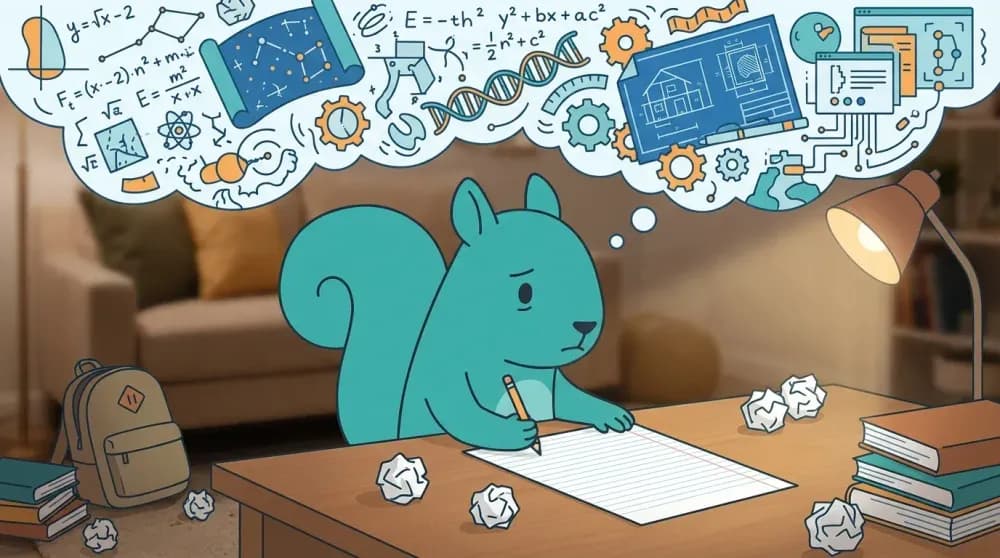
Why gifted underachievers can't write: the executive function gap in twice-exceptional kids and what actually helps.
You know this scene. You've lived it so many times it has its own gravity.
Your child — the one who explained the water cycle to a college student at the science museum last week, the one who taught himself enough Redstone circuitry to build a working elevator in Minecraft, the one who argued you into a corner about the electoral college and was right — is sitting at the kitchen table. In front of him is a sheet of lined paper. At the top it says: Write three sentences about your weekend.
It has been forty-five minutes.
The pencil is now sharpened to a weapon. The eraser shavings have formed a small civilization on the table's edge. There is one word on the page — "I" — and it has been crossed out twice. You are watching a child who can hold an adult conversation about black holes experience genuine cognitive distress over three sentences about Saturday.
And the voice you've been trying to silence, the one that has no business being there because you know better, asks it again: If he's so smart, why can't he just write it down?
Because intelligence and written output are run by different hardware. And in your child's brain, those two systems are not on speaking terms.
Here's the part that may surprise you: what you're watching has a name, and it has a research literature going back more than fifty years.
You may not have thought of your child as "gifted." Most parents in this situation haven't — the word conjures straight-A students and chess prodigies, not the kid who builds a working Minecraft elevator but can't write three sentences about his weekend. You don't need a test score to recognize yourself here. If your child consistently knows more than they can show, if their verbal ability outruns their written output by a country mile, if the grown-ups around them keep saying "so smart" and "not living up to potential" in the same breath — then what you're watching is the pattern researchers call the gifted underachiever. And once you learn what that actually means, almost everything you've been told about your child stops making sense in the right way.
In brief: A gifted underachiever is a high-ability child whose academic output consistently falls short of their measured cognitive potential — the bright kid producing C-level work on a 130+ IQ engine. Between 9% and 28% of gifted students experience underachievement during compulsory education, and writing is the place the gap is widest (Raoof et al., 2024). Gifted underachievement in writing is a neurological processing mismatch, not a motivation problem. Writing is the most executive-function-intensive academic task a child faces — it demands simultaneous coordination of planning, working memory, organization, task initiation, self-monitoring, and fine motor control, all skills governed by a prefrontal cortex that develops on its own timeline. In twice-exceptional (2e) children, intellectual ability often runs years ahead of executive function capacity, creating a canyon between what the child knows and what they can produce on paper. This pattern — called asynchronous development — is one of the most misunderstood profiles in education. The answer isn't "try harder." It's building the scaffolding that bridges the gap between the brilliant mind and the blank page.
Why Writing Is Where It All Falls Apart
Every academic task demands some executive function. Reading requires sustained attention. Math requires working memory. Science requires organization.
Writing requires all of them. At the same time. With no template.
Here's what a writing assignment actually demands from the brain, in real time and in parallel:
- Working memory — holding the topic, the thesis, the supporting evidence, the current sentence, the next sentence, the spelling conventions, the teacher's rubric, and the word you just forgot, all simultaneously
- Task initiation — starting when there is no single correct answer to converge on, no clear first step, no external structure to lean on
- Planning and sequencing — deciding what to say, in what order, with what level of detail, in what voice
- Self-monitoring — evaluating your own output against an internal standard while producing it
- Cognitive flexibility — shifting continuously between generating ideas and critiquing them, between big-picture structure and sentence-level mechanics
- Sustained attention — maintaining focus on a non-preferred task whose reward is deferred by hours, days, or an entire grading period
- Fine motor coordination — orchestrating the precise, sustained hand movements required to physically produce letters on the page, while every other cognitive system is already shouting for bandwidth
Executive function is the brain's project management system — the set of cognitive processes, centered in the prefrontal cortex, that coordinate planning, organizing, initiating, and self-correcting. It is not intelligence. It develops on its own timeline, matures later than almost every other cognitive system, and doesn't fully come online until the mid-twenties (Diamond, 2013).
For most children, the gap between intellectual ability and executive function capacity is narrow enough to be invisible. For twice-exceptional children — those who are both gifted and neurodivergent — the gap is a canyon. And writing is the task that makes the canyon impossible to ignore.
Math has right answers. A gifted brain can often brute-force its way to the solution, sidestepping weak executive function through raw computational power. Reading is absorptive — the brain receives and processes, rather than producing organized output from scratch. But writing is generative. It requires the child to build something from nothing, using the exact cognitive systems that are running three to five years behind the systems generating the thoughts.
That's not a metaphor. A landmark 2007 study by Shaw et al. in Proceedings of the National Academy of Sciences found that children with ADHD reach peak cortical thickness in the prefrontal cortex at a median age of 10.5 years — compared to 7.5 years in typically developing children. In the middle prefrontal region specifically, the delay was approximately five years (Shaw et al., 2007). The brain region responsible for every executive function writing demands is, quite literally, still under construction.
And the prefrontal cortex isn't the only system running behind the intellect. Writing is also a motor act — a deceptively complicated one, demanding fine-grained coordination between fingers, wrist, eye, and internal model of the letter on the page. For many neurodivergent children, the hand isn't ready either. An estimated 30 to 50 percent of children with ADHD also meet diagnostic criteria for Developmental Coordination Disorder — the fine-motor equivalent of a second exceptionality — which makes DCD one of ADHD's most common companions (Lino & Chieffo, 2022). And when the two travel together, handwriting is the first place it shows up: a 2023 systematic review in Children found that every methodologically sound study in the literature documented impaired handwriting quality in ADHD — poorly formed letters, inconsistent sizing, lack of automation, greater pen pressure, greater stroke variability — not because these children don't care how their writing looks, but because the motor-planning system itself is under-resourced (Puyjarinet, Chaix, & Biotteau, 2023).
In gifted populations, the split is often more dramatic still. Christopher Taibbi, writing for Psychology Today, distills what every parent of a twice-exceptional child recognizes instantly: "Many times, the minds of gifted children move much much faster than their fingers can" (Taibbi, 2013). Linda Silverman, who has tested thousands of gifted children over four decades at the Gifted Development Center, has documented the same pattern across that entire population — fine-motor planning lagging years behind verbal and conceptual skill, producing children who can describe a castle in architectural detail but can't yet form the letter k without effort (Silverman, n.d.). The idea has outrun the machinery that would write it down. And the child knows it — which is its own particular form of suffering.
Now layer giftedness on top of that. A gifted child's reasoning systems — pattern recognition, verbal comprehension, abstract thinking — may be running years ahead of schedule. The result: a twelve-year-old with the verbal reasoning of a seventeen-year-old and the executive function capacity of an eight-year-old, sitting in front of a blank page, trying to convert sophisticated thoughts into sequential written sentences using machinery that isn't ready yet.
Research confirms the gap is more extreme in gifted populations. A 2020 study in Gifted Child Quarterly found that among students identified as gifted with ADHD, discrepancies between general cognitive ability and processing speed or working memory were nearly twice as large as those in ADHD-only populations (Maddocks, 2020). The ideas are more complex, more numerous, and more interconnected — which means the working memory demand for writing them down is higher, not lower, than what a typical child faces.
This is why your child can deliver a brilliant oral presentation on marine biology and then hand in a written report that reads like it was composed by a different, much younger student. Verbal expression is largely sequential and automated — ideas flow in real time with minimal executive function overhead. Writing requires the child to externalize thought through a bottleneck of planning, sequencing, and motor output that their brain hasn't finished building.
How Gifted Underachievement Stays Hidden (and the Cliff)
The cruelest feature of the gifted underachiever profile is how long it stays invisible.
Giftedness masks the executive function deficit. The child compensates with raw intellectual horsepower — white-knuckling their way to B's when their EF capacity would predict D's. The school sees "adequate performance." The accommodation requests get denied. The child is burning through cognitive resources just to produce output that doesn't come close to what they actually know, and nobody notices because the grades look fine. Foundational research by Reis and McCoach — the two researchers who shaped the modern definition of gifted underachievement — describes the pattern as a "discrepancy between expected achievement and actual achievement," and estimates that the population of gifted underachievers in U.S. schools may be as large as half of identified gifted students (Reis & McCoach, 2002).
A 2025 systematic review in Frontiers in Education confirmed that this compensatory pattern leads to twice-exceptional children being systematically underidentified and underserved — labeled lazy, unmotivated, or underachieving when they are in fact working harder than any of their peers just to stay afloat (Rizzo, Pinnelli, & Minnaert, 2025). And the ADHD overlap is direct: a 2020 study by McCoach and colleagues examining underachieving gifted students found that while they didn't show elevated hyperactivity, they did show significantly elevated rates of inattention — the quiet, easy-to-miss half of the ADHD presentation that looks exactly like "dreamy kid who doesn't turn in his homework" (McCoach et al., 2020). The gifted underachiever is often an inattentive-ADHD profile in disguise, and the disguise is holding until the demands exceed the compensation.
Then comes middle school.
The academic demands increase. The scaffolding from teachers decreases. Written assignments get longer, more complex, more frequent. And the compensation strategies that carried the child through elementary school — memorizing instead of organizing, talking through answers instead of writing them, relying on short-answer formats — collapse under the weight of five-paragraph essays, research papers, and lab reports.
Parents describe this moment with a specific bewildered terror: What changed? She was fine last year. Nothing changed. The demands exceeded the compensation, and the gap that was always there became visible. The child didn't get less intelligent. The task requirements finally caught up to a processing bottleneck that had been quietly operating in the background for years.
Inside the Freeze: What's Happening When They Stare at the Page
When a 2e child sits motionless in front of a blank sheet of paper, it is not a choice. It is not defiance. It is a neurological traffic jam with at least three colliding factors.
The Working Memory Pileup
Writing demands that multiple pieces of information occupy working memory simultaneously. The topic. The structure. The current sentence. The next sentence. The spelling. The handwriting mechanics (or typing mechanics). The teacher's expectations. The child's own standard for what "good" looks like.
Children with ADHD have significantly reduced working memory capacity — a finding so consistent across studies that a 2024 meta-analysis in Nature Human Behaviour, synthesizing 180 studies, confirmed working memory deficits as a transdiagnostic feature across all neurodevelopmental conditions, with moderate effect sizes that increase in the presence of comorbidities (Astle et al., 2024). For a gifted child, the cruelty is specific: the ideas they're trying to write down are more complex, more layered, and more interconnected than what a typical student would produce. The working memory demand to hold all of that in mind while also managing the mechanics of writing exceeds what their executive function can deliver. The system overloads. The child freezes.
The Initiation Wall
Task initiation — the ability to begin — is an executive function skill, not a motivation outcome. Writing is uniquely hostile to task initiation because it offers no obvious first step. A math problem tells you what to find. A reading assignment tells you where to start. A writing prompt says: produce something from nothing.
For a gifted child, the initiation problem compounds with perfectionism. These children have often built an identity around being "the smart kid." When writing threatens to reveal a gap between what they think and what they can produce, the threat to that identity triggers avoidance. It's not procrastination. It's a specific form of task anxiety: If I don't start, I can't produce something that isn't good enough. If I don't produce something that isn't good enough, I'm still smart. Research on 2e self-perceptions confirms that these children exhibit diminished global self-concept, with low self-esteem and self-efficacy that directly undermines their willingness to attempt challenging tasks (Ronksley-Pavia et al., 2025).
And here's the part that makes perfectionism more than a personality trait: it often is fight-or-flight, wearing a cardigan. Writing is an ambiguous task. There is no answer key. There is no single correct sentence. "What counts as good?" is a question with no defensible answer — and for a nervous system that already runs hot, ambiguity reads as threat. A 2012 PLOS ONE study of 132 children found gifted sixth graders scored significantly higher on self-oriented perfectionism than their non-gifted peers, and self-oriented perfectionism correlated directly with worry and oversensitivity on the anxiety scale (Guignard, Jacquet, & Lubart, 2012). Under the perfectionism, there is a stress response. Under the stress response, there is a prediction engine that has already decided the sentence will be wrong. The child isn't stubborn. Their autonomic nervous system is running.
The gifted child who has rarely experienced academic struggle has no resilience template for the feeling of not being able to do something. Writing gives them that feeling every time. So the brain, doing what brains do, avoids the threat.
The Fatigue Tax
By the time your child gets home from school, they've spent the entire day running gifted-level cognition on an executive function budget that doesn't cover it. Every transition they navigated, every assignment they organized, every social interaction they managed — all of it drew from the same prefrontal cortex resources that writing now demands.
Sustaining gifted-level reasoning while compensating for executive function weaknesses is exhausting in a way that doesn't show on the outside. The homework resistance you see at 4 PM isn't about the assignment. It's about a brain that has spent eight hours doing cognitive heavy lifting that their peers didn't have to do — and now you're asking it to perform the single most EF-intensive task in the curriculum with nothing left in the tank.
What Actually Helps (And What Doesn't)
The instinct — for parents, teachers, and often the child themselves — is to push harder. More effort. More time. More consequences for incomplete work. This approach is precisely backwards. You cannot discipline a prefrontal cortex into maturing faster. What works is building external scaffolding that lets the child produce output without requiring executive function skills they don't have yet — then gradually removing that scaffolding as the skills develop.
The research supports this. Self-Regulated Strategy Development (SRSD), developed by Karen Harris and Steve Graham, is the most extensively studied writing intervention for students with attention and learning difficulties. A meta-analysis found that SRSD yielded an average effect size of 1.14 on writing quality for students with ADHD — a large, clinically significant improvement (Graham et al., 2012). The core principle: teach the strategy explicitly, model it, scaffold the practice, then gradually release responsibility.
Here's how to apply that principle at home.
1. Separate Thinking from Writing
The single most powerful intervention: stop requiring your child to think and write at the same time.
These are different cognitive operations using different neural systems. Forcing them to happen simultaneously is what creates the freeze. Your child doesn't have a thinking problem. They have an output problem. So separate the output channel from the thinking channel.
- Talk first, write second. Have your child explain their essay verbally. Record it on your phone. Then help them transcribe their own words. Most 2e kids are stunned to discover they already "wrote" a sophisticated response — they just did it out loud. The essay was always in there. It just couldn't get out through the writing bottleneck.
- Voice-to-text is not cheating. It's an accommodation for a processing bottleneck — the same category as glasses for a visual processing difference. Removing the motor-planning layer of writing frees working memory for the actual ideas.
- Mind-map before paragraphing. Get ideas out of the head in any non-linear format — sticky notes, whiteboard, visual map — before asking the child to arrange them into sequential paragraphs. The organization step is separate from the generation step.
2. Give Them Permission to Write Badly — and Mean It
If perfectionism is a threat response, the intervention is not a pep talk about self-compassion. It's a structural change in the rules that tells the nervous system the threat is gone.
Loosen the rules. Lower the stakes. Explicitly remove the standard. Tell your child, in plain language that you actually mean: This draft is allowed to be bad. It is supposed to be bad. The worse it is, the more you're doing it right. You are not being indulgent. You are giving a stressed prefrontal cortex permission to start, which is the single thing it cannot do on its own.
This isn't new advice and it isn't soft. Writer Anne Lamott, in her 1994 book Bird by Bird, famously called the first draft the "shitty first draft" — not as a joke, but as a working strategy. "Almost all good writing begins with terrible first efforts," she wrote. "You need to start somewhere" (Lamott, 1994). Twenty years earlier, writing theorist Peter Elbow had developed the same insight into a method he called freewriting — ten minutes of uninterrupted, unedited, uncritical writing whose only rule is that you cannot stop moving the pen. Elbow's core insight: the critical voice and the generative voice cannot share a room. If you force them to, the generative voice always loses. Separating them — by giving the writer explicit, structural permission to produce something nobody will judge, not even them — breaks the freeze (Elbow, 1998). Decades of writing research have since confirmed that writing anxiety and maladaptive perfectionism consistently predict worse writing outcomes, not better ones — and that interventions which reduce the anxiety outperform interventions that try to raise the standard.
Try any of these at your kitchen table:
- The no-one-will-read-it draft. Promise your child, with a straight face and genuine commitment, that the first draft is private. You will not read it. The teacher will not read it. It will be destroyed or painted over or saved only for them. This isn't a bribe — it's removing the observer that perfectionism is performing for.
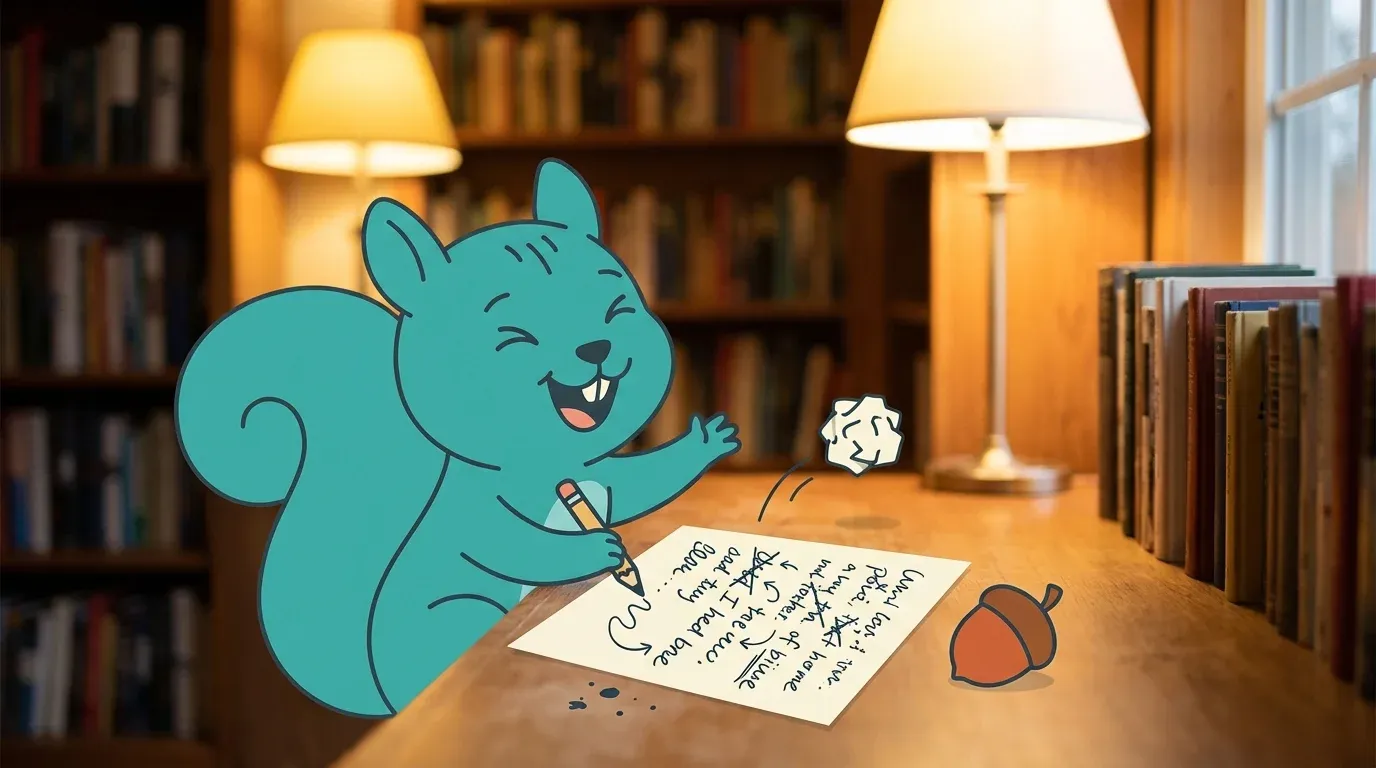
- The deliberately terrible sentence. Before they start the real writing, ask them to write one sentence that is intentionally as bad as they can make it. Bonus points if it's funny. The point is to prove to the nervous system that bad writing does not end the world. Laughing at a deliberately awful sentence is a more effective anxiety intervention than any amount of "you can do this."
- The five-minute mess. Set a timer. Tell them: "For the next five minutes, you are not allowed to write anything good. You are required to write badly. Grammar is banned. Structure is banned. If a beautiful sentence shows up by accident, cross it out." Then watch what happens. Most 2e kids will start laughing by minute two and writing real sentences by minute four.
- Name the trap out loud. "Your brain is telling you that if the sentence isn't perfect, you're not smart. That's a lie your brain tells you when it's scared. The sentence is allowed to be ugly. You are still smart either way." Speaking the fear in plain language, rather than tiptoeing around it, deflates it in a way that praise never will.
This strategy works precisely because it's honest about what's happening. You're not tricking your child. You're meeting the threat response where it actually lives — in the rules, not in the feelings — and changing the rules so the body doesn't need to sound the alarm.
3. Provide the Structure Their Brain Hasn't Built Yet
The child's internal organizational system for writing is under construction. Don't wait for it. Build the external version and let them borrow it.
- Paragraph frames. A visual template: topic sentence → evidence → analysis → transition. The child supplies the content; the architecture is already there. This removes the planning load and lets working memory focus on ideas instead of structure.
- Sentence starters. "The most important thing about [topic] is..." removes the terrifying blankness of the empty page. Task initiation is the hardest step. Give them the first three words.
- Checklists, not instructions. Instead of "write a five-paragraph essay," provide: ☐ Write your main idea in one sentence. ☐ List three things that support it. ☐ Write two sentences about the first one. Breaking the monolithic task into discrete, completable micro-tasks transforms "impossible" into "tedious but doable."
4. Reduce the Cognitive Load
Every unnecessary demand you remove from the writing process frees up working memory for the content that matters.
- Draft one is for ideas only. Grading handwriting, spelling, grammar, and content simultaneously overwhelms the system before it starts. First draft: get the ideas down. Second draft: fix the mechanics. Third draft (if needed): polish. Never all at once.
- Let them type. Handwriting adds motor planning demands on top of cognitive demands. For many 2e children, a keyboard removes an entire layer of bottleneck. If the school insists on handwritten work, that's an accommodation conversation worth having.
- Shorten the assignment, not the thinking. "Write three sentences explaining why the Roman Empire fell" demands the same analytical reasoning as a five-paragraph essay with 80% less executive function overhead. The cognitive rigor is in the thinking, not the word count.
5. Build Time Awareness Around Writing
Gifted children with ADHD often have no idea how long writing actually takes them — a specific manifestation of time blindness. They don't experience writing as "30 minutes of work." They experience it as an undifferentiated block of suffering with no edges.
- Estimate, then measure. "How long do you think this paragraph will take?" Then time it. Don't correct the estimate — just let the child see the gap. That gap between prediction and reality is where metacognitive awareness develops. It's the same principle behind Squirrel's Executive Loop: estimate, execute, measure, learn.
- Use structured intervals. Twenty minutes of focused writing followed by a five-minute break is dramatically more productive than an open-ended "sit there until it's done." The open-ended format triggers both time anxiety and task avoidance. The bounded format contains the discomfort: I can do anything for twenty minutes.
- Celebrate the session, not just the product. Completing a twenty-minute writing session is its own achievement, whether the essay is finished or not. Research on the Progress Principle shows that a sense of small, incremental progress is the single most powerful driver of sustained engagement (Amabile & Kramer, 2011).
6. Name It So They Can Work With It
The executive function strategies won't land if the child has already decided that writing is proof they're not actually smart. The identity threat has to be addressed directly, with language that gives the child a framework for what's happening — one that doesn't involve being stupid, lazy, or broken.
- Explain the mismatch. "Your brain thinks in 3D, and writing is a 1D output channel. That's a bandwidth problem, not a you problem." This isn't sugarcoating. It's neuroscience translated into language a gifted child can understand and use.
- Normalize the gap. Many of the most original thinkers in history had the same processing mismatch. The connection between exceptional thinking and difficult output is well-documented in gifted populations — and the adults who learn to work with it, rather than against it, are often the ones producing the most creative work in their fields.
- Explore with questions, not commands. "What's the hardest part about starting this?" works better than "Just start writing." Inviting the child into the problem-solving process — treating them as a collaborator rather than a compliance problem — builds both executive function and autonomy (Davidson Institute, 2025).
The Long Game
Here's what the panic in the middle of the homework battle makes it hard to remember: executive function is not fixed.
The prefrontal cortex is still developing. The skills your child lacks at twelve are not the skills they'll lack at twenty-two. Research consistently shows that metacognitive interventions — explicitly teaching children to plan, monitor, and evaluate their own cognitive processes — produce significant and sustained improvement, with effect sizes maintained at follow-up (Dignath & Büttner, 2024). The scaffolding you build now isn't a crutch. It's construction equipment — temporary external structure that the brain gradually internalizes as its own prefrontal systems come online.
And here's the part nobody puts in the parenting books: your child's writing will probably always be harder than it "should" be relative to their thinking. The gap may narrow, but for many 2e individuals, the mismatch between the speed of thought and the speed of written output is a permanent feature of their cognitive architecture. That's not a tragedy. It's a design specification. The same asynchronous development that makes a five-paragraph essay feel like running through wet concrete also produces the kind of lateral, multi-dimensional thinking that makes connections nobody else sees.
The adults who figure this out — the former gifted underachievers who find their voice through dictation, typing, visual thinking, collaborative writing, or simply choosing work that values their thinking over their formatting — don't look back on the homework battles as the defining chapter. They look back on them as the problem they eventually solved. Usually not by getting better at writing the way school wanted them to. Usually by finding a better way to get what was in their head out into the world.
Your job isn't to close the gap. It's to help your child build the bridge — and to keep believing in what's on the other side of it, even on the nights when three sentences take two hours.
Frequently Asked Questions
What if my child has never been formally identified as gifted?
You are not in the wrong place. The majority of children who fit the gifted underachiever pattern are never formally identified, because identification usually happens via the exact system — school achievement — that the child is struggling in. IQ testing is expensive, gatekept, and often skipped altogether when a child's grades look "fine enough." Many 2e kids spend their entire K-12 run undiagnosed on both axes: nobody spots the giftedness because the output is unremarkable, and nobody spots the executive function weakness because the grades are buoyed by intelligence just enough to land in "adequate." If the scene at the kitchen table feels familiar — the verbal reasoning that outruns the written output, the brilliant oral explanation followed by a written response that reads like it came from a much younger child, the grown-ups who keep saying "so smart" and "not living up to potential" in the same breath — then the article is for you, regardless of whether the word "gifted" has ever been applied to your child on paper. If you want to pursue formal identification, a comprehensive neuropsychological evaluation is the tool that captures both the giftedness and the hidden executive function gap in a single assessment.
What is a gifted underachiever?
A gifted underachiever is a high-ability child whose academic output consistently and significantly falls short of what their measured cognitive potential would predict. The construct was formalized by Reis and McCoach (2002), who defined it as a sustained discrepancy between expected achievement (from IQ, standardized tests, or teacher-identified potential) and actual achievement in the classroom. Gifted underachievement typically emerges in elementary school but becomes most visible in middle school, when organizational demands spike and the compensation strategies that carried the child through early grades run out. Between 9% and 28% of gifted students meet the definition during compulsory education (Raoof et al., 2024), though some researchers estimate the real population is considerably higher — up to half of identified gifted students (Reis & McCoach, 2002). Importantly, most gifted underachievers are never formally identified as gifted at all — the pattern recognizes the child, not a test score. It is not a motivation problem or a character flaw. It is a mismatch between the child's cognitive wiring and the output channels school is asking them to use.
What are the characteristics of a gifted underachiever?
The core characteristics of a gifted underachiever, drawn from Reis and McCoach's foundational research and confirmed by subsequent reviews, include:
- A persistent gap between potential and performance — verbal reasoning or reading in the 95th+ percentile while written output lands at or below grade level
- Selective engagement — brilliant on preferred topics, apparently incapable on assigned ones (this is an executive function pattern, not a choice)
- Low academic self-concept despite high ability — a child who believes they "aren't actually smart" because schoolwork feels so hard
- Perfectionism that looks like procrastination — an identity-protective avoidance of tasks where the output might reveal the gap
- Elevated inattention symptoms (without necessarily hyperactivity) — the quiet half of ADHD, often undiagnosed because the child isn't disruptive (McCoach et al., 2020)
- Middle-school collapse — a specific, recognizable cliff around ages 11-13 when organizational demands outpace compensation
- Adequate-to-good grades masking underlying struggle — the most dangerous feature, because it delays identification for years
Importantly, gifted underachievement is not a permanent trait — it is a reversible pattern when the child's actual cognitive architecture is understood and supported with the right scaffolding.
Why can my gifted child explain complex ideas verbally but can't write a simple paragraph?
Verbal expression and written expression use fundamentally different cognitive pathways. Speaking is largely sequential and automated — ideas flow in real time with minimal executive function overhead. Writing requires simultaneous coordination of planning, organization, working memory, motor output, and self-monitoring, all managed by the prefrontal cortex. For twice-exceptional children whose executive function development lags behind their intellectual ability, writing demands skills their brain hasn't fully built yet, while verbal reasoning may be years ahead of age. The gap is a processing bottleneck between thought and written output, not a reflection of intelligence or effort.
Is my child's writing difficulty dysgraphia, ADHD, or giftedness?
It can be any combination, and in 2e children these conditions frequently co-occur and interact. Dysgraphia affects handwriting and written expression at the motor and language-processing level. ADHD affects the executive function skills needed to plan, organize, initiate, and sustain effort during writing. Giftedness adds perfectionism, the masking effect, and the intensity of ideas that exceed working memory capacity. A comprehensive neuropsychological evaluation is the best way to untangle which factors are contributing — the key word being comprehensive, because brief screeners and classroom behavior checklists miss the nuance of the 2e profile. These aren't mutually exclusive diagnoses, and effective support often addresses all three simultaneously.
At what age does the writing gap usually become a problem?
The gap often becomes visible around ages 8-10 but reaches crisis point in middle school (ages 11-13), when written assignments get longer, more complex, and more frequent while teacher scaffolding simultaneously decreases. If your child has been identified as gifted but consistently underperforms on written work, produces writing that doesn't reflect their verbal ability, avoids or melts down over writing tasks, or takes dramatically longer than peers to complete written assignments, those are signals worth investigating — not with panic, but with curiosity. Early identification of the executive function gap allows you to build scaffolding before the child develops a fixed negative identity around writing.
Will my child grow out of this?
Executive function continues developing into the mid-twenties, and metacognitive training demonstrably accelerates that development. Many 2e children show meaningful improvement in writing production as their prefrontal cortex matures, especially with appropriate scaffolding, accommodations, and explicit strategy instruction. However, some degree of mismatch between thinking speed and output speed often persists into adulthood. The goal isn't to eliminate the gap — it's to build strategies and tools that let your child produce work that reflects their actual thinking. Many successful 2e adults describe finding their workaround: dictation, collaborative writing, visual frameworks, or choosing work where the quality of their ideas matters more than the speed of their written production.
How do I get the school to take this seriously when grades are "fine"?
This is the masking problem in action. When a gifted child compensates enough to earn B's, the school sees adequate performance and has no incentive to evaluate further. Start by documenting the discrepancy: the oral presentation that was brilliant versus the written version that was three incoherent sentences. Time how long assignments take versus how long they're designed to take. Request a comprehensive evaluation — you have the legal right to this under IDEA — focused specifically on the gap between cognitive ability and written output. Neuropsychological testing that reveals a large discrepancy between the General Ability Index and the Processing Speed or Working Memory indices provides the evidence schools need to justify accommodations under a 504 plan or IEP.
References
Amabile, T.M. & Kramer, S.J. (2011). "The Power of Small Wins." Harvard Business Review, May 2011. Article
Astle, D.E., et al. (2024). "Executive function in children with neurodevelopmental conditions: A systematic review and meta-analysis." Nature Human Behaviour, 8, 1098-1112. Full text
Davidson Institute. (2025). "Executive Functioning and Gifted Children." Article
Diamond, A. (2013). "Executive functions." Annual Review of Psychology, 64, 135-168. PMC
Dignath, C. & Büttner, G. (2024). "Metacognition interventions: A meta-analysis." Metacognition and Learning. Springer
Elbow, P. (1998). Writing Without Teachers (2nd ed.). New York: Oxford University Press. Goals and Benefits of Freewriting (PDF)
Graham, S., McKeown, D., Kiuhara, S., & Harris, K.R. (2012). "A meta-analysis of writing instruction for students in the elementary grades." Journal of Educational Psychology, 104(4), 879-896. SRSD Online
Guignard, J.-H., Jacquet, A.-Y., & Lubart, T.I. (2012). "Perfectionism and Anxiety: A Paradox in Intellectual Giftedness?" PLOS ONE, 7(7), e41043. PLOS ONE
Lamott, A. (1994). Bird by Bird: Some Instructions on Writing and Life. New York: Pantheon Books. "Shitty First Drafts" excerpt (PDF)
Lino, F. & Chieffo, D.P.R. (2022). "Developmental Coordination Disorder and Most Prevalent Comorbidities: A Narrative Review." Children (Basel), 9(7), 1095. PMC
Maddocks, D.L.S. (2020). "Cognitive and Achievement Characteristics of Students From a National Sample Identified as Potentially Twice-Exceptional (Gifted With a Learning Disability)." Gifted Child Quarterly, 64(1), 3-18. PDF
McCoach, D.B., Siegle, D., & Rubenstein, L.D. (2020). "Pay attention to inattention: Exploring ADHD symptoms in a sample of underachieving gifted students." Gifted Child Quarterly, 64(2), 100-116. APA PsycNet
Puyjarinet, F., Chaix, Y., & Biotteau, M. (2023). "Is There a Deficit in Product and Process of Handwriting in Children with Attention Deficit Hyperactivity Disorder? A Systematic Review and Recommendations for Future Research." Children (Basel), 11(1), 31. PMC
Raoof, K., Shokri, O., Motahhari Nejad, H., & Zebardast, A. (2024). "Unpacking the underachievement of gifted students: A systematic review of internal and external factors." Heliyon, 10(17), e37219. PMC
Reis, S.M. & McCoach, D.B. (2002). "Underachievement in gifted and talented students with special needs." In M. Neihart, S.M. Reis, N.M. Robinson, & S.M. Moon (Eds.), The social and emotional development of gifted children: What do we know? (pp. 81-91). Waco, TX: Prufrock Press. PDF
Rizzo, A., Pinnelli, S., & Minnaert, A. (2025). "Twice-exceptional students: A systematic review to outline the distinctive characteristics through a multidimensional lens." Frontiers in Education, 10, 1696805. Full text
Ronksley-Pavia, M., et al. (2025). "The Self-Perceptions of Twice-Exceptional Children: A Systematic Review." Education Sciences, 15(1), 44. MDPI
Shaw, P., et al. (2007). "Attention-deficit/hyperactivity disorder is characterized by a delay in cortical maturation." Proceedings of the National Academy of Sciences, 104(49), 19649-19654. PMC
Silverman, L.K. (n.d.). "Poor Handwriting: A Major Cause of Underachievement." Gifted Development Center. PDF
Taibbi, C. (2013). "The Dilemma: The Young Gifted and (Lack of) Fine Motor Skills." Psychology Today, April 29, 2013. Article
Topics
Why we wrote this
We didn’t write this article because we researched a market opportunity. We wrote it because we lived it — the years of “he’s just not trying,” the neuropsych evaluation that finally explained everything, the domain-by-domain work of helping a neurodivergent child build the executive function scaffolding that school never provided.
Then we built Squirrel — an executive function platform designed from the inside — because the gaps in executive function aren’t just about missed homework and lost shoes. They’re the root of the social isolation, the emotional dysregulation, and the slow erosion of confidence that neurodivergent people carry long after childhood. We built the tool we wished we’d had.
Join the Beta