
Should You Get a Neuropsychological Evaluation for ADHD? A Parent's Guide
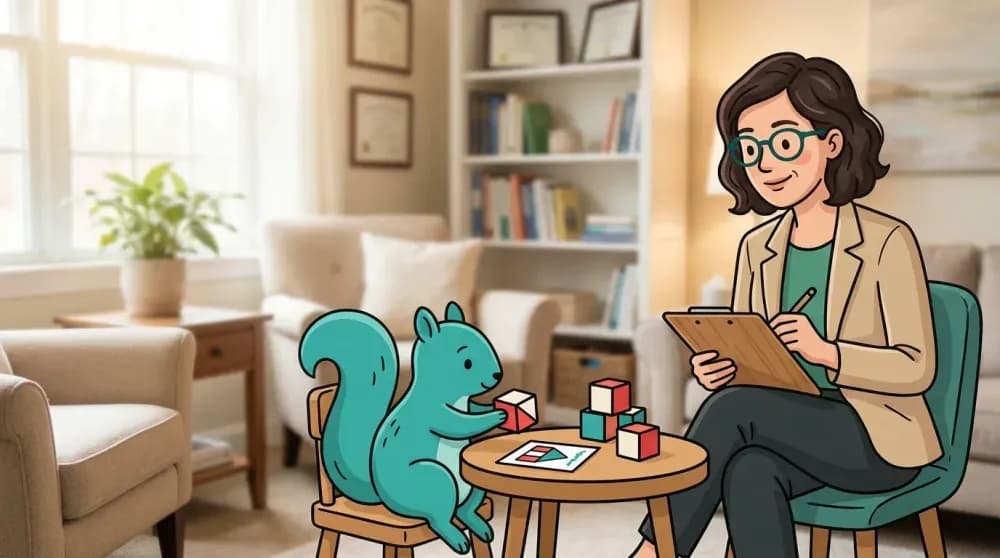
School mornings are a battle. The teacher says "he's not trying." Therapy isn't helping. A neuropsych eval reveals what everyone has been missing.
You're reading this because something isn't adding up.
Maybe school mornings have become a battleground — tears, rage, physical resistance, the kid who can recite Napoleon's Maxims of War but cannot (will not, may be genuinely unable to) get their shoes on by 7:42. Maybe you've joined the school refusal forum groups in Facebook. Maybe the teacher sent another email about "lack of effort" and you know it's something else but can't name what. Maybe you've been in anxiety therapy for eighteen months and nothing is getting better. Maybe your pediatrician said "watch and wait" — which is, in our experience, what pediatricians say when they don't know what to do and are hoping the problem will solve itself before the next appointment. Maybe your gut has been telling you for two years that something is structurally different about how your child's brain works, and teachers, doctors and even psychologists are missing the mark or reluctant to tell you what they think.
You're in the right place.
Here's what nobody tells you: for most families, it takes years — sometimes half a childhood — to finally learn that a neuropsychological evaluation even exists, let alone that it might explain the thing you've been trying to name since kindergarten. Years of "he'll grow out of it." Years of "just try harder." Years of bedtime conversations where you reassure your child that they are not, in fact, stupid or lazy or bad, while privately wondering if you're the one who's broken. Years of watching other families seem to just… have kids that go to school in the morning, like it's a normal thing people do.
A neuropsychological evaluation is often the first time anyone helps you understand the why — why school is this hard, why mornings are like this, why therapy isn't moving the needle, why your kid can build a working pulley system out of Legos on Saturday and fail a spelling test on Monday, why the same child who explained orbital mechanics at dinner cannot remember to bring home a worksheet. It's not a fix. It's not a cure. But it is, for a huge number of families, the first honest map anyone has drawn of the territory you've been lost in.
In this guide, we hope to provide some clarity — on what a neuropsychological evaluation actually is, why it so often turns out to be the missing piece, and how to use it once you have it. Whether you're years into the struggle or just starting to suspect something deeper is going on, we're glad you're here.
In brief: A neuropsychological evaluation is a comprehensive 6-12 hour assessment of how your child's brain actually works — mapping cognitive ability, processing speed, working memory, executive function, attention, memory, language, and emotional functioning into a single detailed profile. For families dealing with school refusal, unexplained anxiety, homework battles, the "bright but failing" pattern, or the "we don't see it at school" gridlock, this is the assessment that reveals what everyone has been missing. It produces the document that reframes every conversation with schools, therapists, and doctors — from behavior problem to neurological profile. For twice-exceptional children — gifted and neurodivergent — it is often the first time anyone sees the whole picture: the extraordinary peaks alongside the hidden valleys, the strengths and struggles that have been hiding behind each other the whole time.
If Any of These Sound Like Your Week
If you can't tell whether a neuropsych eval is the right next step, read the list below. If any of these sound like your week — or, more likely, most of them do — keep reading.
The 7 AM standoff. Your child is on the floor, half-dressed, refusing to put on shoes. You've tried calm. You've tried stern. You've tried bribes. You've tried the sticker chart the therapist recommended in 2024, which now lives in a drawer with the other artifacts of hope. Nothing moves them. By 7:52 you're crying in the car and they're crying in the backseat and everyone is late. This is school refusal, even if nobody in your life has used the phrase yet.
The teacher email. "He's such a bright boy, but he's not meeting expectations." "She seems unfocused." "He doesn't turn in his work even when I can see he understood the material." You've read this email in six different forms across four different teachers, and the pattern is starting to feel less like "my kid has bad luck with teachers" and more like "something is going on that these teachers are not trained to see." (Spoiler: the second one.)
The four-hour homework war. A worksheet your child could do in their sleep takes four hours, three meltdowns, and a screaming match. You sit next to them, thinking your presence will help. They freeze anyway. The pencil sits on the paper. The answer they clearly know will not come out. You have Googled "why can't my child do their homework" more times than you want to admit, and the answers are never quite right.
The therapy that isn't working. You've been seeing a wonderful, credentialed, thoughtful therapist for a year. Your child likes her. Your child is not getting better. The anxiety looks exactly the same as it did in session three. You've started wondering whether you're doing something wrong, whether the therapist is missing something, or whether you're both missing the thing underneath the anxiety entirely. (It is almost always door number three.)
The "we don't see it at school" gridlock. Every evening your child comes home and collapses into sensory overload, emotional dysregulation, and physical exhaustion so complete they cannot eat dinner. Every day the teacher cheerfully says "he had a great day!" You are being told, gently but persistently, that the problem must be happening at home — which means, by implication, that the problem is you.
The capability-output gap. Your child can explain things you don't understand. They read three grade levels above their age. They built a functioning pulley system out of Legos last weekend because they felt like it. Their report card has three Cs and an F. Every adult in the system is telling your child — and telling you — to "just try harder," as if trying harder were a switch anyone in this story has failed to flip.
The middle school wall. Everything was fine through 4th grade. Your kid was "bright and a little quirky" and everyone assumed they were going to be fine. Now it's 6th grade and nothing is fine. Homework is undone. Backpacks are lost. Grades are falling. The compensation strategies that worked for five years stopped working, and no one can tell you why.
The rage that doesn't match the trigger. A broken pencil tip becomes a 45-minute meltdown. A schedule change turns into three hours of despair. A denied snack request ends in the bedroom door being slammed so hard the frame cracked. You're watching your child suffer wildly disproportionately to the input, and you've started to understand that their nervous system is operating on different rules than other kids'.
The sensory meltdown over the tag in the shirt. Every morning, the shirt. Every night, the pajamas. Every meal, the food that's touching other food. You are not imagining it — you are watching real sensory processing differences that your pediatrician keeps telling you "most kids grow out of," while your gut tells you this kid is not "most kids."
The anxiety that looks like defiance. Your child isn't refusing school because they are defiant. They are refusing school because they are terrified, and the fear is so large they cannot access the words to describe it, so it comes out as "I won't" instead of "I can't." Everyone in the system — teacher, therapist, grandparent, the guy at the hardware store who has opinions — keeps telling you to hold a firmer line. Your gut is telling you that holding a firmer line is going to break something you cannot unbreak.
The "too smart to have ADHD" dismissal. A pediatrician or school psychologist has told you, with confidence, that your child cannot have ADHD because he got a perfect score on standardized math tests. This is still a thing professionals say, despite decades of evidence that giftedness, ADHD and Autism can coexist more frequently than anyone's diagnostic model accounts for. A neuropsych eval is the assessment that finally sees both.
If any of these sound like your week — or your month, or your last five years — a neuropsychological evaluation is very probably the next step. Here's what that actually means, and why it works.
When School Has Become the Battleground
For a huge segment of families reading this, the trigger for seeking an evaluation isn't a developmental concern in the abstract. It's a school problem that has escalated into a crisis. School refusal. Homework wars. Behavioral incidents. IEP meetings where you are told, in careful language, that your child is the problem.
If that's where you are, understand this clearly: the school has become a battleground because the school system is misreading your child, and neither side has the information to fix it alone. A neuropsychological evaluation is the document that breaks that deadlock.
School refusal is a signal, not defiance
School refusal gets framed as a behavioral problem. It is very rarely a behavioral problem. For neurodivergent children, school refusal is almost always a nervous system signal — the body saying "I cannot tolerate what you are about to make me do" in the only language it has left.
What's underneath varies by child:
- Sensory overload from fluorescent lights, cafeteria noise, uniform fabric, the constant proximity of twenty-five other small bodies
- Executive function collapse when the demands (multi-step instructions, transitions, independent work) exceed the child's capacity to execute even tasks they clearly understand
- Social anxiety that's less about shyness and more about unreadable social rules and the constant threat of getting them wrong in public
- Anticipatory anxiety about a teacher, a subject, a transition, a fire drill that happened three weeks ago and is still in the child's working memory like a tab they can't close
- Autistic burnout — a recognized pattern of chronic exhaustion from sustained masking, which looks like defiance from the outside and feels like drowning from the inside
- Dabrowski's overexcitabilities — see the next section — which can amplify every sensory, emotional, and imaginational input by an order of magnitude
None of these are "not wanting to go to school." They are all "my nervous system has decided it cannot do this today," which is a very different thing and responds to very different interventions.
The "he's capable when he wants to be" translation
You have probably heard some version of this sentence from a school professional. "He's capable of doing this work when he wants to be." "We've seen her do it on good days." "He knows the material — he's just choosing not to engage."
Here is the translation: "We are observing inconsistent performance, and we have defaulted to the assumption that the inconsistency is a motivation problem, because we do not have the tools to see that it's a neurological one."
This is not malice on the school's part. Most classroom teachers have not been trained to recognize the difference between "won't" and "can't" in a neurodivergent child. They are pattern-matching with the tools they have, which come from an industrial-era model of education that assumed a normal distribution of neurotypical learners. Your child is outside that distribution, and the pattern-matching is failing.
A neuropsych eval gives you the vocabulary the school does not have. "He has a 53-point gap between Verbal Comprehension and Processing Speed" is a sentence that ends the motivation conversation, because that is not something a child can choose.
The "we don't see it at school" gridlock
If you have had the experience of watching your child collapse every afternoon while the teacher insists everything is fine, you have encountered one of the most specific and most painful forms of 2e parenting. The child is masking at school — suppressing stims, suppressing anxiety, suppressing sensory distress, running their executive function system at 180% capacity to approximate neurotypical behavior — and then releasing the entire day's accumulated load the moment they are somewhere safe.
This is called "after-school restraint collapse," and it is extraordinarily common in gifted-ND children. From the outside, it looks like home is the trigger. From the inside, it is the exact opposite: home is the only place safe enough for the collapse to happen. The school hasn't seen "it" because the child has spent seven hours making sure they don't.
A neuropsych eval resolves the gridlock because it produces standardized, scientifically valid scores that are not subject to "but we don't see it." The school has to reckon with the numbers whether they observed the behavior in class or not.
The eval as advocacy leverage
Here is what the neuropsych report actually is, in practical terms: the most powerful advocacy document you will ever have in an IEP meeting.
A 25-page report from a board-certified pediatric neuropsychologist — with DSM-5 diagnoses, standardized scores, confidence intervals, and specific recommendations — is not the same kind of document as a parent concern letter. It cannot be dismissed as "helicopter parenting." It cannot be minimized as "every child is different." It is, in the eyes of federal disability law, a legally significant clinical assessment — and it obligates the school to consider its findings in good faith.
That shift alone — from "concerned parent advocating against skeptical institution" to "clinical evidence under IDEA review" — changes every conversation that follows. It is the single most consequential reframe available to you, and for many families it is the only reason their child finally gets the accommodations they have needed for years.
The Compound Pattern: Overexcitabilities, Anxiety, and Executive Dysfunction
Scroll through any forum for parents of twice-exceptional children and you will find the same presenting complaint, written by different parents, about different children, in almost identical language:
"My child refuses to go to school. He's incredibly bright. He has constant meltdowns over small things. The anxiety is through the roof. The school thinks he's being defiant. He's in therapy but nothing is helping. I don't know what to do."
This is not a coincidence of phrasing. It is a recognizable compound pattern with a recognizable underlying mechanism, and it is one of the most common reasons parents end up seeking a neuropsych eval. Here is what is actually happening inside that compound.
Dabrowski's overexcitabilities, briefly
In the 1960s, the Polish psychiatrist Kazimierz Dabrowski described a pattern of heightened nervous-system responsiveness that he believed was characteristic of gifted individuals. He called these heightened responses overexcitabilities (OEs), and identified five types:
- Psychomotor — the kid who literally cannot sit still, fidgets constantly, talks nonstop, runs instead of walks
- Sensual — the kid for whom a scratchy tag isn't a minor annoyance but a sensory emergency
- Intellectual — the kid whose brain never stops asking questions, following tangents, researching one thing while you're trying to talk about another
- Imaginational — the kid with vivid inner worlds, elaborate daydreams, and fears about things that have not happened and are not likely to happen but feel as real as things that have
- Emotional — the kid whose joys and sorrows and rages run at higher amplitude than the situation seems to warrant, and who feels other people's feelings as though they were their own
Any gifted child may have one or more OEs. Many twice-exceptional children have several. See our guide on Dabrowski's overexcitabilities for the full landscape.
How OEs compound with ADHD and anxiety
Here is a nuance that rarely makes it into standard clinical training: OEs are not a separate thing that merely resembles ADHD, anxiety, and autism from a distance. They occur across the spectrum of all three — more like a Venn diagram or a continuum than a set of separate boxes. Psychomotor OE shares territory with ADHD hyperactivity. Emotional OE overlaps with anxiety and mood regulation. Sensual OE shades into sensory processing differences. Imaginational OE and anxious rumination can be indistinguishable from the outside. In many children, the OE and the clinical condition are the same profile viewed through different lenses — the intensity dimension running through whatever else is going on.
The Dabrowski framework for describing this intensity lives mostly in gifted-education literature. It is not in the DSM, not in most psychiatry residencies, not in most clinical psychology programs, and not in the CBT protocols a generalist therapist is trained on. A well-meaning clinician may simply never have encountered it as a lens at all — which means the child in front of them is being interpreted through a framework that was never built to see them whole.
And here is the other uncomfortable truth: giftedness and actual ADHD, actual anxiety, and actual sensory processing differences frequently coexist in the same child. Overexcitabilities are not a substitute for those diagnoses. They are often the symptoms you are actually seeing — the emotional storms, the sensory meltdowns, the physical restlessness, the imaginational spirals — that a clinician then tries to fit into a DSM category. A child with both ADHD and emotional OE is not "hyperactive and sensitive" in parallel. They are experiencing ADHD through a nervous system with the volume dial set to 11, because intensity is how their wiring expresses itself.
Now add executive dysfunction — the specific ADHD-linked inability to plan, sequence, initiate, sustain, and switch — and you have a child whose day looks like this:
- Wakes up with emotional OE already running, because the anxiety about today's unknown started during last night's sleep
- Experiences sensory OE at breakfast — the wrong cereal, the tag in the shirt, the light in the kitchen is wrong somehow
- Hits executive function collapse trying to get shoes on, backpack packed, lunch remembered
- Encounters the imaginational OE as their brain generates every possible thing that could go wrong at school today, in vivid sensory detail
- Refuses to leave the house, because the cumulative load has exceeded what their nervous system can process before 8 AM
From the school's perspective: "He's fine, he just doesn't want to come to school."
From the child's perspective: "My entire body is telling me this is unsafe and I cannot explain why."
From the parent's perspective: "I have been losing this fight for three years and I don't know who to ask."
Why the eval is the specific next step
A neuropsychological evaluation is one of the very few assessments in the field built to distinguish between — and map interactions among — all of these layers at once. A good evaluator will:
- Measure cognitive ability with enough granularity to identify giftedness and its scatter pattern
- Assess executive function directly, not just via parent/teacher rating scales
- Screen for ADHD, anxiety, depression, and autism spectrum characteristics
- Recognize overexcitabilities as a temperament pattern distinct from — and often co-occurring with — clinical conditions
- Synthesize all of the above into a description of how this specific child is actually operating, rather than a checkbox of which diagnoses apply
This is why the same parents who have spent two years in anxiety therapy with no progress will often say, within weeks of getting their neuropsych report, that they finally understand their child for the first time. The report is not a new diagnosis. It is a map — the first map anyone has drawn of the territory they've been lost in.
The Anxiety Treatment Trap
If you have been in anxiety therapy with your child for more than twelve months and nothing is materially better, pause here. You may be in a very specific trap.
Anxiety as symptom vs. anxiety as disorder
Clinical anxiety disorders respond to evidence-based treatment. CBT works. Exposure therapy works. Even plain-old routine accommodations move the needle for most kids within three to six months. If anxiety is the primary disorder, treatment should be producing visible change. You should see something shift.
If nothing is changing after twelve or eighteen or twenty-four months of solid therapy with a solid clinician, the most likely explanation is not that the treatment is wrong or the clinician is bad. It is that the anxiety is not the primary disorder. It is a symptom of something underneath — and until you identify the thing underneath, treating the anxiety is like bailing out a boat without looking for the hole.
The thing underneath is usually one or more of:
- Unidentified ADHD with executive dysfunction. Kids who cannot plan, sequence, or initiate become chronically anxious about the next task, the next transition, the next expectation they cannot meet. The anxiety is downstream of the ADHD, not parallel to it. Treating the anxiety while the executive function deficit goes unaddressed is slow-motion futility.
- Unidentified twice-exceptionality. A gifted child who is also neurodivergent learns very early that something is wrong with them, even if they can't name it. Some spend childhood and adolescence performing neurotypicality, developing a pervasive anxiety that no amount of CBT will touch — because it is rooted in a survival strategy, not a cognitive distortion.
- Unidentified autism spectrum characteristics. Autistic children frequently present with anxiety as the headline complaint, because their nervous systems are operating in environments not built for them. Treating the anxiety without recognizing the autism is like prescribing ibuprofen for a broken leg. Helpful at the margins. Non-curative.
- Unidentified sensory processing differences. A child whose nervous system is chronically overloaded by ambient sensory input will develop anxiety as a downstream consequence. You can do all the CBT worksheets in the world and the overhead lights will still be too bright.
- Dabrowski's overexcitabilities running at high amplitude, which, as covered above, look identical to anxiety to anyone not trained to see the distinction.
The specific conversation to have with yourself
If you are in this trap, the signal is usually this: your therapist is good, your child likes her, you believe in the approach — and the anxiety is exactly where it was when you started. Maybe it has new topics now. But the level, the frequency, the impact — unchanged.
A neuropsych evaluation is often the single most efficient way out of the trap. It either (a) confirms the anxiety is in fact the primary disorder — which validates the current treatment approach and gives you permission to keep going — or (b) reveals the profile that has been driving the anxiety all along, at which point treatment can finally re-aim at the actual target and things start to move.
Either way, you get out of the trap. The trap is the part where you don't know which door you're behind.
One note before we move on: CBT itself is not the problem. How CBT is structured for a neurodivergent family — who's in the chair, how the parent's own nervous system becomes part of the treatment, and the specific leverage a neurodivergent father can bring when the report reveals his own wiring alongside his child's — is substantial enough to deserve its own article. A companion guide on CBT for neurodivergent families is in the works.
What a Neuropsychological Evaluation Actually Tests (for ADHD, 2e, and Beyond)
A neuropsychological evaluation — sometimes called neuropsychological testing — isn't a single test. It's a comprehensive battery of assessments that maps your child's cognitive landscape across every major domain of brain function. Think of it as a topographic survey of the mind — it doesn't just tell you the altitude. It shows you every peak, every valley, and the terrain between them.
The Cognitive Domains
| Domain | What It Reveals | Why It Matters for Your Child |
|---|---|---|
| Intellectual Ability (IQ) | Verbal comprehension, visual-spatial reasoning, fluid reasoning | Identifies giftedness — and reveals when a composite score is hiding the real picture |
| Processing Speed | How quickly the brain handles simple information | The "hidden weakness" in bright kids — when a fast mind runs on a slow clock |
| Working Memory | Holding and manipulating information in mind | Why your child can't follow three-step directions despite understanding each step individually |
| Executive Function | Planning, organization, inhibition, cognitive flexibility, task initiation | The command center — and the first thing to lag behind in ADHD and 2e profiles |
| Attention | Sustained, selective, and divided attention | Distinguishes ADHD subtypes from anxiety-based inattention — they look identical from outside |
| Academic Achievement | Reading, math, written expression | Identifies specific learning disabilities hiding behind intelligence |
| Memory & Learning | Immediate vs. delayed recall, verbal vs. visual memory | Why your child remembers everything about dinosaurs but nothing about this morning |
| Language | Receptive and expressive language, phonological processing | Catches language differences that mimic or compound ADHD |
| Visual-Spatial | Visual perception, construction, spatial reasoning | Affects math, handwriting, and navigating spaces |
| Emotional/Behavioral | Anxiety, depression, emotional regulation | Maps co-occurring conditions that amplify everything else |
The most commonly used instruments include the WISC-V (Wechsler Intelligence Scale for Children) for cognitive ability, the WIAT-4 (Wechsler Individual Achievement Test) for academics, the NEPSY-II for neuropsychological functions, the BRIEF-2 for executive function ratings, and the Conners 4 for ADHD symptom measurement. Your child's evaluator will select specific instruments based on the referral questions — not every child gets every test.
What These Tests Actually Look Like
Parents often ask what specific tasks their child will be doing during a neuropsych eval. Here are three of the most commonly administered WISC-V subtests:
- Block Design. Your child is given a set of small red-and-white cube blocks and a printed pattern card. The task is to arrange the blocks to match the pattern within a time limit. This measures visual-spatial reasoning and processing speed. A gifted child with slow processing speed will often see the solution instantly and then struggle to execute it — a gap that shows up nowhere else as clearly.
- Symbol Coding. Your child copies simple symbols into numbered boxes on a grid, as fast as they can, within two minutes. The score is a count of how many correct symbols they produced, which is why it is one of the most sensitive subtests for identifying the "hidden weakness" in bright kids who think faster than their hands can move.
- Digit Span. The evaluator says a sequence of numbers and your child repeats them back — first in the same order, then in reverse. This measures working memory, which is the single most common lag in ADHD and executive function profiles.
The rest of a neuropsych battery looks similar — hands-on puzzles, pattern recognition, timed paper-pencil tasks, memory games, word tasks. It is deliberately structured to feel more like a series of challenges than a school test, and most children report they found it interesting (even when they found it hard).
The Scatter Pattern: Where the Real Story Lives
For families navigating the gifted-ADHD overlap, the most revealing finding isn't any single score. It's the scatter pattern — the gap between the highest and lowest subtest scores.
Research from the Gifted Development Center found that gifted children show an average gap of 27.4 points between their Verbal Comprehension score and their Processing Speed score. When index scores vary by 23 points or more, the Full Scale IQ becomes statistically uninterpretable — it's like reporting a runner's "average speed" when they sprinted the first mile and crawled the second.
A child with Verbal Comprehension at 145 and Processing Speed at 88 gets a composite around 115 — "high average" — which tells you almost nothing about their lived experience. The scatter pattern is the diagnostic signature of twice-exceptionality, and a neuropsychological evaluation is often the first assessment comprehensive enough to see it. The AACN consensus statement (Guilmette et al., 2020) established uniform score labeling precisely because the field recognized how easily these numbers are misinterpreted.
This is why advocacy for 2e children sometimes requires requesting the General Ability Index (GAI) — which excludes Working Memory and Processing Speed — instead of the Full Scale IQ. When a child's FSIQ is artificially depressed by executive function deficits, the GAI reveals the intellectual capacity that the composite is hiding.
Not All Testing Is Created Equal
Parents hear "testing" and assume it's all the same. It's not. The differences determine what answers you get — and what you miss.
| School Evaluation | Psychological Evaluation | Neuropsychological Evaluation | |
|---|---|---|---|
| Who | School psychologist | Licensed clinical psychologist | Neuropsychologist with specialized postdoctoral training |
| Question answered | "Does this child qualify for services?" | "What psychiatric diagnoses apply?" | "How does this brain learn, think, regulate, and process?" |
| Duration | 2-4 hours | 3-6 hours | 6-12 hours |
| Diagnosis | No DSM diagnosis — educational categories only | DSM-5 diagnoses | DSM-5 diagnoses + comprehensive cognitive profile |
| Cost | Free (IDEA mandate) | $1,500-$3,500 | $2,500-$7,000 |
| What's missing | Executive function, memory, attention depth | Educational/academic focus | Nothing — but cost and wait times are the trade-off |
The critical distinction: A school evaluation determines eligibility. A neuropsychological evaluation explains how the brain works. For a straightforward presentation, the school evaluation may be enough. For anything complex — and twice-exceptional children are definitionally complex — the neuropsych eval is the one that reveals the full picture.
One more thing the school won't tell you: if you disagree with any part of the school's evaluation, you have the legal right to request an Independent Educational Evaluation (IEE) at public expense under IDEA. The district must either pay for the independent evaluation or file due process to prove their own evaluation was adequate. Most districts pay — it's cheaper than lawyers.
What to Expect: The Evaluation Timeline
Knowing what's coming makes the whole process less overwhelming. Here's the typical arc.
Before the Evaluation
Wait time reality: Expect 6-12 months for a pediatric neuropsychological evaluation (ResearchGate, "Improving Wait Times for Pediatric Neuropsychology Services"). There are approximately 1,400 board-certified clinical neuropsychologists in the United States, with only about 280 specializing in pediatric cases — for the entire country (ABPP Workforce Mapping). Each evaluation requires 6-12 hours of face-to-face testing plus scoring and report writing. The math doesn't work.
How to reduce the wait:
- University training clinics often have shorter waitlists and dramatically lower costs ($300-$1,725 on sliding scale). Testing is done by supervised doctoral students using the same instruments, with reports reviewed by licensed neuropsychologists. UCLA, University of Houston, Columbia, and Colorado State all run well-regarded clinics.
- Hospital teaching programs (Mount Sinai, Columbia) offer reduced-fee evaluations through externs and fellows, with sliding scales as low as $200-$1,000.
- Telehealth hybrid models are expanding access, particularly for rural families. A 2025 crossover study of 476 youth found that telehealth-delivered neuropsych testing showed excellent agreement with in-person results (ICCs of 0.91-0.95 for Full Scale IQ).
During the Evaluation
| Phase | Duration | What Happens |
|---|---|---|
| Intake interview | 1-2 hours | The neuropsychologist interviews you (and ideally both parents) about developmental, medical, educational, and family history. Bring everything: previous evaluations, teacher notes, IEP documents, medication lists. |
| Testing sessions | 6-8 hours (1-3 days) | Your child does puzzles, pattern recognition, word games, memory tasks, computer-based activities, and paper-pencil exercises. It's structured like a game — not a school test. Breaks for snacks, bathroom, and regrouping are built in. |
| Scoring & report writing | Behind the scenes | The neuropsychologist integrates all data, writes a comprehensive report (typically 15-30 pages), and formulates diagnoses and recommendations. |
| Feedback session | 60-90 min (2-4 weeks later) | You meet to discuss findings, diagnoses, and specific recommendations. This is the session where things start to make sense. |
| Written report | 4-6 weeks | The full document that becomes the foundation for everything that follows. |
How to prepare your child: Frame it honestly and simply. For younger children: "We're going to meet someone who does puzzles and thinking games." For teens: "This will help us understand how your brain learns best — some parts will be easy, some will be hard, and that's exactly the point." The key message: "No one gets everything right. Just try your best."
Understanding the Report
The report arrives. It's 20+ pages. It has tables of numbers, percentile ranks, standard scores, confidence intervals, and clinical language. Your eyes glaze.
Here's what actually matters.
How to Read the Scores
Reports use standard scores with a mean of 100 and a standard deviation of 15. The AACN Uniform Labeling System provides the framework:
| Standard Score | Percentile | What It Means |
|---|---|---|
| 130+ | 98th+ | Exceptionally High |
| 120-129 | 91st-97th | Above Average |
| 110-119 | 75th-90th | High Average |
| 90-109 | 25th-74th | Average |
| 80-89 | 9th-24th | Low Average |
| 70-79 | 2nd-8th | Below Average |
For 2e parents: The individual index scores and subtest scores matter more than any composite. If you see Verbal Comprehension at 135 and Processing Speed at 82, that 53-point gap is the story — not the "high average" composite that hides both extremes. That scatter pattern is the fingerprint of twice-exceptionality.
Confidence intervals appear as ranges (e.g., "IQ: 112, 95% CI: 108-116"). No test measures perfectly. The range is where the true score lives. Focus on patterns and ranges, not individual numbers — especially when comparing across domains.
Sections to Read First
Skip to the end. Summary & Impressions integrates everything. Recommendations tells you what to actually do. Then go back and read the domain-by-domain results to understand the "why" behind the recommendations. The developmental history section is written for the school — you already know it.
What to Do with the Results
The report is not the finish line. It's the starting document.
For most parents, the neuropsych report is the first piece of documentation they have ever had that is scientifically valid, clinically comprehensive, and legally significant under federal disability law. It is, functionally, the key that unlocks every door that has been closed to you up until now — the IEP the school wouldn't grant, the accommodations that were refused, the diagnoses that weren't "official" enough, the services that required "more evidence," the therapists who needed specific targets instead of generic concerns, the family members who didn't believe you.
Understand what you now have. It is not a diagnosis. It is a map of your child's brain, backed by a credentialed specialist, accepted under IDEA, and legally required to be considered by the school team in good faith. That is enormous. Here's how to use it.
School Accommodations: IEP vs. 504 Plan
| IEP | 504 Plan | |
|---|---|---|
| Law | IDEA | Section 504, Rehabilitation Act |
| Provides | Specialized instruction + accommodations + measurable goals | Accommodations only |
| Eligibility | 1 of 13 disability categories + need for specialized instruction | Any disability substantially limiting a major life activity |
| For 2e kids | Can include both disability accommodations AND gifted services | Accommodations only — no gifted mandate |
For twice-exceptional children, advocate for both: accommodations that address executive function (extended time, reduced written output, access to technology, preferential seating) AND enrichment that respects intellectual depth (independent projects, advanced content, mentorship). Not either/or. Both. Children with disabilities cannot legally be denied access to gifted programs.
The IEP Meeting: How to Use the Report
- Invite the neuropsychologist. Most will attend by phone. Expert-to-expert dialogue with school specialists is more productive than parent-vs-school dynamics.
- Provide the report in advance — at least a week before the meeting — so the team has time to review.
- Prepare your list: specific accommodations, goals, and services you believe are necessary, tied directly to the report's recommendations.
- Bring someone. A spouse, advocate, or therapist. You're entitled to bring anyone — just give advance notice.
- Know your IEE rights. If the school's evaluation missed what the neuropsych found, you can request a publicly-funded independent evaluation. The school must comply or file due process. Most districts pay rather than litigate.
Beyond School: Therapeutic Direction
The neuropsych report doesn't just serve the school. It guides therapeutic interventions:
- Executive function support calibrated to the specific profile — not generic strategies, but tools matched to where the gaps actually are. Time blindness, task initiation, working memory — each has different interventions. Squirrel is built specifically for executive function support in neurodivergent families, with tools that adapt to the kind of profile a neuropsych eval reveals.
- Therapist selection informed by the diagnosis — OT for sensory and motor differences, CBT for anxiety that's compounding executive dysfunction, social skills groups matched to the child's actual social perception profile.
- Understanding overexcitabilities in context — the report can help a skilled clinician distinguish between Dabrowski's overexcitabilities and diagnosable conditions, or recognize when both are present simultaneously.
The Cost Conversation: What It Actually Takes
Let's be direct about the money, because nobody else is.
What You'll Pay
| Setting | Cost Range | Notes |
|---|---|---|
| Private practice | $2,500-$5,000 | Up to $7,000 for complex cases. Includes intake, testing, scoring, report, and feedback. |
| Hospital-based | $6,000+ | Facility fees add up. May be more likely to accept insurance. |
| University training clinic | $300-$1,725 | Sliding scale. Same instruments, supervised doctoral students, expert-reviewed reports. |
Insurance Reality
Insurance may cover neuropsych testing deemed "medically necessary" — diagnosing ADHD, evaluating cognitive function after brain injury, assessing developmental concerns. Coverage varies wildly by plan, and educational testing embedded within the eval is rarely covered even when the clinical portion is. Expect reimbursement of $0-$1,400 on out-of-network claims, leaving significant out-of-pocket regardless.
Call your insurance before scheduling. Ask specifically about CPT codes 96132/96133 (neuropsychological evaluation) and 96136-96139 (test administration). Get the answer in writing.
When Money Is Tight
- University training clinics are the best-kept secret in neuropsych. Waitlists are often shorter, costs are a fraction, and the quality is comparable.
- Request an IEE if you disagree with the school's evaluation. The district pays.
- County mental health systems offer free or low-cost assessments for income-eligible families.
- Sliding scale practices exist — ask directly. Many neuropsychologists adjust fees.
- Medicaid generally doesn't panel neuropsychologists directly, but may cover testing through county community health networks. Some states (like North Carolina through Alliance Health) have removed prior authorization requirements.
The cost is real. For families already spending on therapy, tutoring, and accommodations, another $3,000-$5,000 is not nothing. But this is the document that makes everything else more targeted, more efficient, and more likely to work. Families who've been through it consistently say the same thing: "We wish we'd done it sooner."
How to Find the Right Evaluator
Not all neuropsychologists understand twice-exceptionality. The ones who do will change everything.
Where to search:
- ABPP Directory — Board-certified clinical neuropsychologists, including the Pediatric Clinical Neuropsychology subspecialty. This is the highest credential in the field.
- AACN Directory — American Academy of Clinical Neuropsychology. Filter for pediatric specialists.
- Psychology Today Directory — Broader, includes non-board-certified providers. Cast a wider net, but verify credentials.
- Davidson Institute — Guidance on finding evaluators who understand 2e specifically.
What to ask a prospective evaluator:
- "Do you have experience with twice-exceptional children?" — If they haven't heard the term, keep looking.
- "Will you analyze subtest scatter, not just composite scores?" — The answer must be yes.
- "Do you assess executive function separately from IQ?" — Essential for 2e identification.
- "Will the report include recommendations for both accommodations and enrichment?" — You need both.
- "Can you attend the IEP meeting by phone?" — The best evaluators expect this question.
Frequently Asked Questions
What is a neuropsychological evaluation?
A neuropsychological evaluation is a comprehensive assessment of brain function conducted by a licensed neuropsychologist. It measures cognitive ability, processing speed, working memory, executive function, attention, memory, language, academic achievement, and emotional functioning through 6-12 hours of standardized testing. Unlike a standard psychological evaluation that focuses on psychiatric diagnosis, a neuropsych maps how the brain processes information across all cognitive domains — producing a detailed report that reveals the specific pattern of strengths and weaknesses underlying a child's daily experience.
Is a neuropsychological evaluation even necessary for ADHD?
Russell Barkley — the most prominent ADHD researcher of the last thirty years — has publicly argued that neuropsychological testing is not necessary for diagnosing straightforward ADHD (Barkley, 2019, "Neuropsychological Testing is Not Useful in the Diagnosis of ADHD: Stop It (or Prove It)!"). He is right, for that case. If your child has clear, textbook ADHD with no other complicating factors, a well-administered clinical interview with a knowledgeable provider may be sufficient, and the testing dollars may be better spent elsewhere. The case for a neuropsychological evaluation is not pure ADHD. It is the complex case — the twice-exceptional child, the bright child who is failing, the anxious child who is not responding to anxiety treatment, the school-refusing child whose presentation has three explanations at once, the child whose profile does not fit a single DSM box. For those children, the test is built exactly to see what a structured interview cannot. If your child's presentation is unambiguous, take Barkley's advice. If it isn't, read on.
How much does a neuropsychological evaluation cost?
A pediatric neuropsychological evaluation typically costs $2,500-$5,000 in private practice, with hospital-based evaluations running $6,000 or more. University training clinics offer the same assessments on a sliding scale, often $300-$1,725. Insurance may partially cover testing deemed medically necessary, but reimbursement varies widely by plan and educational components are rarely covered. Financial options include university clinics, Independent Educational Evaluations (IEE) funded by school districts, county mental health programs, and sliding-scale private practices.
What's the difference between a neuropsych and a psychological evaluation?
A psychological evaluation primarily diagnoses psychiatric and developmental conditions (ADHD, anxiety, autism) through 3-6 hours of testing focused on emotional and behavioral functioning. A neuropsychological evaluation does everything a psychological evaluation does plus maps the full cognitive landscape — processing speed, working memory, executive function, memory, language, visual-spatial processing, and academic achievement — across 6-12 hours. For straightforward presentations, a psychological evaluation may suffice. For complex or unclear profiles, especially in twice-exceptional children, the neuropsych reveals the complete picture.
How long does a neuropsychological evaluation take?
The evaluation involves 6-12 hours of direct testing, typically spread across 1-3 days, plus a 1-2 hour parent intake interview. After testing, the neuropsychologist scores and integrates results into a comprehensive report (15-30+ pages) over 2-4 weeks. A feedback session (60-90 minutes) follows, with the written report delivered 4-6 weeks after testing. The full process from intake to report typically spans 6-10 weeks — not counting the 6-12 month wait for an initial appointment.
Can the school refuse to accept the neuropsych results?
The school must consider the results, but is not required to adopt every recommendation. Under IDEA, the IEP team must review outside evaluations as part of their decision-making process and hold an IEP meeting (typically within 30 days) to discuss the findings. If you disagree with how the school interprets or implements the results, you have due process rights — including requesting mediation or filing a due process complaint. Having the neuropsychologist attend the IEP meeting significantly increases the likelihood that recommendations are adopted.
My child has school refusal — is a neuropsychological evaluation the right next step?
Usually, yes. School refusal is almost never a pure behavioral problem — it is a nervous system signal, and the underlying drivers (executive dysfunction, anxiety, sensory overload, autistic burnout, Dabrowski's overexcitabilities, or some combination of these) are exactly what a neuropsychological evaluation is built to identify. Before scheduling, it is also worth ruling out acute issues like bullying, a specific teacher conflict, or an unaddressed trauma — but once those are accounted for, a neuropsych eval is often the fastest route to understanding why the refusal is happening and what specifically will help. For many families, it's also the document that finally convinces the school that school refusal is not a discipline issue.
We've been in anxiety therapy for two years and nothing is working. What now?
If anxiety treatment with a good clinician has not moved the needle in twelve-plus months, the anxiety is very likely a symptom of something the therapy hasn't identified yet — unrecognized ADHD with executive dysfunction, undiagnosed twice-exceptionality, autism spectrum characteristics, sensory processing differences, or overexcitabilities running at high amplitude. A neuropsychological evaluation is one of the most efficient ways to break out of this trap. It either confirms the anxiety is the primary disorder (in which case you continue the current approach with more confidence) or reveals the underlying profile that has been driving the anxiety all along (in which case treatment can finally re-aim at the actual target, and things start to move).
The school says they don't see what we see at home. How does a neuropsych eval help?
The "we don't see it at school" dynamic is one of the most specific and painful forms of parenting a gifted or twice-exceptional child — and it is often a sign that your child is masking all day, holding executive function together through sheer will, and collapsing the moment they reach a safe space. A neuropsychological evaluation resolves the gridlock because it produces standardized, scientifically valid scores that the school cannot dismiss as parental perception. The report obligates the IEP team to consider findings in good faith under IDEA, regardless of what teachers observe in the classroom. In practice, this reframe — from "concerned parent vs. skeptical school" to "clinical evidence under federal review" — is the single most consequential shift available to you.
Can a neuropsychological evaluation help with Dabrowski overexcitabilities?
Yes, when you work with an evaluator who understands them. Overexcitabilities (OEs) are a temperament pattern, not a clinical diagnosis — but a skilled neuropsychologist can recognize the signature and distinguish it from, or identify its co-occurrence with, ADHD, anxiety, sensory processing differences, and autism spectrum characteristics. This distinction matters enormously, because overexcitabilities respond to accommodation, pacing, and validation, not to behavior modification or medication aimed at a mis-identified disorder. When you interview potential evaluators, ask directly: "Do you have experience with gifted children and Dabrowski's overexcitabilities?" If the answer is a confused pause, keep looking.
Is neuropsychological testing useful for diagnosing ADHD and autism together?
Yes, and this is one of the cases where the test earns its price. ADHD and autism co-occur in a substantial fraction of diagnosed individuals, and they look similar from the outside while producing very different underlying cognitive, executive, and sensory profiles — which means a clinical interview alone routinely catches one condition and misses the other. A neuropsychological evaluation maps the specific pattern of a child's brain across all the relevant domains and is one of the few assessments comprehensive enough to distinguish ADHD-only from autism-only from co-occurring presentations. If you have ever been told "it's just ADHD" or "it's just autism" and the interventions aren't working, this is frequently why — and identifying the full picture is what lets the right supports finally click into place.
How many years do families usually spend in confusion before getting an evaluation?
There is no formal epidemiological study on this, but clinicians who work with twice-exceptional children consistently report the same pattern: most families spend three to seven years in escalating confusion, failed interventions, and generic therapy before anyone mentions a neuropsychological evaluation. A huge part of the delay is that the professionals parents encounter first — pediatricians, school psychologists, generalist therapists — are rarely trained to recognize complex neurodivergent profiles. If you have been in the confusion for two or more years and things are getting worse rather than better, you have almost certainly earned the right to stop waiting for someone else to suggest the eval and schedule it yourself.
References
Assessment Instruments & Standards
- Barkley, R. A. (2019). "Neuropsychological Testing is Not Useful in the Diagnosis of ADHD: Stop It (or Prove It)!" The ADHD Report, 27(2), 1-8. (Counterposition engaged in the FAQ section.)
- Guilmette, T.J., et al. (2020). "AACN Consensus Conference Statement on Uniform Labeling of Performance Test Scores." The Clinical Neuropsychologist, 34(3), 437-453.
- Gifted Development Center. WISC-V score patterns in gifted children — 27.4-point average gap between Verbal Comprehension and Processing Speed.
- Gilman, B.J., Peters, D.B., & Silverman, L.K. (2026). "Strength-Based Assessment for Twice-Exceptional Children." SAGE Open.
Twice-Exceptional Identification
- Frontiers in Education (2025). "Twice-exceptional students: A systematic review to outline distinctive characteristics through a multidimensional lens."
- Beretta, V. & Pfeiffer, S.I. (2024). "Prevalence of Twice-Exceptional Students." Education Sciences, 14(10), 1048.
- Davidson Institute. "Twice Exceptional: Definition, Characteristics & Identification."
- Davidson Institute. "Clarification of Federal Law as It Applies to Twice-Exceptional Students."
Diagnostic Journey
- Crane, L., et al. (2016). "Experiences of Autism Diagnosis: A Survey of over 1000 Parents in the United Kingdom." Autism, 20(2), 153-162.
- Webb, J.T., et al. (2016). Misdiagnosis and Dual Diagnoses of Gifted Children and Adults. Great Potential Press.
Telehealth & Access
- PubMed (2025). Home telehealth neuropsychological testing crossover study — 476 youth, ICCs 0.91-0.95 for FSIQ.
- Springer (2026). TENT (Telehealth Enabled Neuropsychological Testing) platform.
Evaluation Process & Cost
- Children's Hospital Colorado. Neuropsychological evaluation guide for families.
- Child Mind Institute. "How to Get an Independent Neuropsychological Evaluation."
- ABPP Directory. Board-certified neuropsychologists searchable by specialty and location.
- AACN Directory. American Academy of Clinical Neuropsychology provider search.
IEP & Educational Rights
- NCLD. "IEPs vs. 504 Plans."
- Parent Center Hub. "Independent Educational Evaluation" — IDEA rights overview.
- Disability Rights California. "How to Obtain an IEE at Public Expense."
- Wrightslaw. Independent evaluations and school advocacy.
Neuropsychological Report Interpretation
- ABPP. Summary of AACN labeling recommendations.
- Ekdom Neuropsychology. Twice-exceptional evaluation services.
Workforce & Access Data
- ABPP Workforce Mapping. Board-certified neuropsychologist distribution.
- ResearchGate. Improving wait times for pediatric neuropsychology services.
School Refusal & Avoidance
- Kearney, C. A. (2008). "School absenteeism and school refusal behavior in youth: A contemporary review." Clinical Psychology Review, 28(3), 451-471.
- Heyne, D., & King, N. J. (2004). "Treatment of school refusal." In P. M. Barrett & T. H. Ollendick (Eds.), Handbook of interventions that work with children and adolescents: Prevention and treatment. Wiley.
Overexcitabilities & Gifted Intensity
- Daniels, S., & Piechowski, M. M. (2009). Living with Intensity: Understanding the Sensitivity, Excitability, and Emotional Development of Gifted Children, Adolescents, and Adults. Great Potential Press.
- Dabrowski, K. (1964). Positive Disintegration. Little, Brown and Company.
Autistic Masking & Burnout (After-School Restraint Collapse)
- Raymaker, D. M., et al. (2020). "Having all of your internal resources exhausted beyond measure and being left with no clean-up crew: Defining autistic burnout." Autism in Adulthood, 2(2), 132-143.
- Pearson, A., & Rose, K. (2021). "A conceptual analysis of autistic masking: Understanding the narrative of stigma and the illusion of choice." Autism in Adulthood, 3(1), 52-60.
Topics
Why we wrote this
We didn’t write this article because we researched a market opportunity. We wrote it because we lived it — the years of “he’s just not trying,” the neuropsych evaluation that finally explained everything, the domain-by-domain work of helping a neurodivergent child build the executive function scaffolding that school never provided.
Then we built Squirrel — an executive function platform designed from the inside — because the gaps in executive function aren’t just about missed homework and lost shoes. They’re the root of the social isolation, the emotional dysregulation, and the slow erosion of confidence that neurodivergent people carry long after childhood. We built the tool we wished we’d had.
Join the Beta